Five Top Tips to Make a Smooth Transition to Retirement

If you’re approaching retirement, you’re probably feeling two things at once: excited about the freedom ahead, and a bit uncertain about what it’ll actually be like. That’s normal. Retirement is one of the biggest changes you’ll go through, and how smoothly it goes has a lot to do with how deliberately you approach it. Here are five things that genuinely help, drawn from what I’ve seen work for people making this exact transition.
Understanding what retirement actually is
Retirement isn’t just a date in the diary. It carries weight on two fronts: how you feel about it, and how you fund it. Both matter, and people tend to plan hard for one while ignoring the other.
For most people it’s the end of a long career, and the emotional side of that is easy to underestimate. There’s real relief in it. After decades of early alarms and someone else’s deadlines, you finally get to step back and enjoy what you’ve built. The freedom is the part everyone looks forward to, no fixed schedule, no obligations tied to a job, time to actually do the things you’ve been putting off.
But there’s a flip side that catches people out. The routine goes. So does the daily contact with colleagues, and the quiet sense of purpose that a job provides whether you notice it or not. It’s worth seeing that coming. The people who handle it best tend to fill the gap on purpose, with something that gives them a reason to get going in the morning, whether that’s volunteering, a community group, or a project of their own.
The emotional side
Retirement is a genuine shift in identity, not just routine, so a mix of excitement and anxiety is completely normal. It’s worth taking the time to think about what retirement actually means to you. What do you value? What have you been wanting to do? How do you picture a good week looking? That bit of reflection up front is what turns a vague “I’ll figure it out” into a retirement that feels like yours.
One of the most useful things you can do is talk to people who’ve already done it. Join something tied to your interests, and get into conversations with people a few years ahead of you. Their version won’t be your version, but you’ll pick up more from one honest chat with someone who’s lived it than from any amount of planning in the abstract.
It’s also a chance to put yourself first for once. Your wellbeing, things you’ve always fancied trying, a new language, picking up a brush, finally seeing the places on the list. Retirement hands you the time. The question is what you do with it.
The financial side
The money side comes down to one question: will what you’ve built (savings, pensions, investments) last as long as you do? Start by being honest about where you stand. Add up what you’ve got, and work out roughly what income it’ll throw off from your pensions, investments and anything else. If that feels like guesswork, this is exactly the point where a financial planner earns their keep, because the decisions you make here are hard to undo later.
One thing people routinely forget is inflation. The cost of living keeps climbing across a retirement that might run thirty years, so the income that feels comfortable today won’t stretch as far in 2045. Build that in from the start, rather than getting a nasty surprise a decade in.
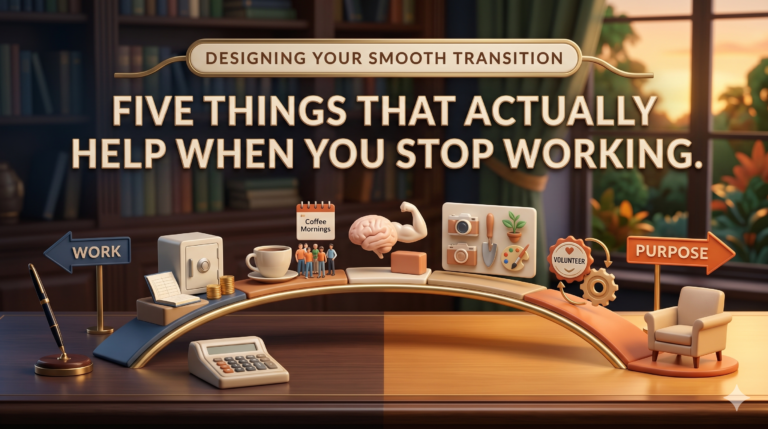
The five tips to retirement transition
With the emotional and financial groundwork in place, here are the five that make the biggest practical difference.
1. Create a retirement budget
This is the foundation. Look at your income, your savings and your spending, and work out what you can comfortably spend without watching the pot drain faster than it should. Circumstances change, so don’t set it once and forget it, check in on it and adjust as you go.
The trick that helps most is splitting your spending into two buckets: the essentials (housing, food, bills) and the discretionary (holidays, eating out, the fun stuff). Knowing where that line sits gives you a lever to pull. In a bad year you can ease off the discretionary spending and leave the essentials untouched, which keeps you in control rather than reacting in a panic.
2. Stay socially active
Retirement can quietly shrink your social life, especially once the daily contact with colleagues disappears. The fix is to be deliberate about it rather than assuming it’ll sort itself out. Join groups, clubs or organisations built around things you actually enjoy. Reconnect with old friends and be open to new ones. It’s not just about filling time, staying connected genuinely affects how well and how happy you feel.
3. Look after your body and mind
Get some regular movement into your week, whether that’s a gym, a class, or simply a proper walk. Exercise does the obvious good for your body, and it lifts your mood too, which matters more once the structure of a working day is gone. Keep your mind working as well. Taking on something that stretches you, a language, an instrument, a skill that makes you feel like a beginner again, keeps you sharp in a way that passive entertainment never will.
4. Explore new hobbies and interests
Retirement finally gives you time for the things work always crowded out. Take up a sport, learn an instrument, get into the garden, try something you’ve never had a spare hour for. Activities that you can actually get better at bring a real sense of progress and purpose, which is exactly what tends to go missing when nobody’s setting you targets anymore.
It’s worth finding a local club or group around whatever you pick up. Painting, photography, cooking, whatever it is, doing it alongside other people gives you both the hobby and the company in one go. You stay mentally active and you meet people who are into the same thing, which is no small bonus.
5. Consider part-time work or volunteering
Stopping work doesn’t have to mean stopping completely. Plenty of people find the smoothest version of retirement is the gradual one: a few days a week, some consultancy, or giving time to a cause they care about. It keeps a bit of structure in the week and a sense of doing something that counts.
Volunteering, in particular, is a satisfying way to give back, mentoring, helping out a local charity, teaching something you’re good at. Part-time or consultancy work scratches a similar itch, a bit of purpose and mental stimulation, while still leaving you most of the freedom you retired for. There can be a financial angle too, easing the early drawdown on your pension, though that’s one to run the numbers on properly rather than assume.
Above all, go into it with the right frame of mind. Treat these five as a starting point and retirement becomes something you’ve designed rather than something that’s just happened to you.
The challenges to watch for
Retirement is something to look forward to, but it’s not without its bumps. Spot them early and they’re far easier to handle.
Loneliness
If a lot of your social life ran through work, its absence can hit harder than you’d expect. Get ahead of it. Community groups, volunteering, hobbies that put you in a room with other people, all of it helps. The relationships you build outside of work are what give retirement its texture, so it’s worth putting real effort in here.
Health
Things crop up as we get older, that’s just the deal, and the trick is staying ahead of them rather than reacting. Keep up with the people who look after your health, and give yourself the best shot with the basics: regular movement, sensible eating, and the check-ups it’s tempting to skip. Look after the fundamentals and you protect the active, enjoyable retirement you’ve been working towards.
Get your head around both sides of retirement, the feelings and the finances, put a bit of thought into the five tips above, and you set yourself up for a transition that’s smooth rather than jarring. Go in with optimism and a bit of intention, and these can genuinely be some of the best years you’ve had.
This is general financial education, not personal advice. Your own situation, particularly anything to do with pensions, tax and drawdown, deserves a proper look before you make any decisions.
Written by Jamie Kyte, a fully qualified, FCA-regulated Independent Financial Adviser at Kyte Financial Planning (www.kytefp.co.uk) based in London.
Newsletter Sign-Up
Looking For Retirement Advice?
Complete our short questionnaire and you’ll be put in touch with a Chartered Financial Planner who will discuss your personal situation with you.
Take a FREE Retirement Quiz...
It’s time to see if you’re on track with your goals, and what changes (if any) need to be made.